





Insidely's free pocket guide

Tink's Pocket Guide

Every look inside, with every source.

Everything Tink has looked inside so far, with every source we checked, so you can look for yourself.

Episodes2
Sources12
Updated18 October 2026
PriceFree

To keep a copy, pick "Save as PDF" as the printer.

  1. Episode 2 Transport

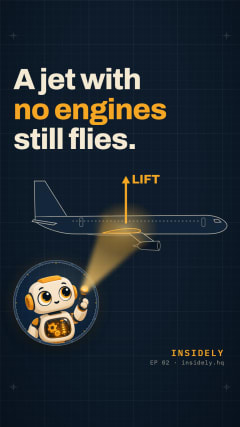
    Why don't planes fall out of the sky when the engines go quiet?
    Cover for Why don't planes fall out of the sky when the engines go quiet?

    The aha

    Wings, not engines, hold a plane up, so a jet with dead engines becomes a heavy glider that trades height for distance.

    In plain English

    A jet with no engines still flies. So why doesn't it drop? Wings hold planes up, not engines.

    Air rushing over the wings makes lift. Engines off, gravity tips it into a shallow glide. The wings keep working.

    An airliner covers fifteen to twenty metres for every metre it drops. In 2001, an Air Transat jet ran dry over the Atlantic. It glided about one hundred and twenty kilometres to the Azores.

    All three hundred and six people survived. That's how a jet with no engines still flies.

    Sources (5)

    1. Glide ratio means more distance travelled for each unit of height lost, and a higher lift-to-drag ratio gives a shallower glide: NASA Glenn Research Center, https://www1.grc.nasa.gov/beginners-guide-to-aeronautics/drag-to-lift-ratio
    2. Airliners glide about 15 to 20 metres for every metre they drop: a typical narrowbody jet (A320, 737) about 17 to 1, and widebodies such as the A330 or 777 about 18 to 1 to 20 to 1: Migflug, Both Engines Dead: Can Jets Survive?, https://migflug.com/jetflights/?p=804281
    3. Air Transat 236 (Airbus A330-243, 24 Aug 2001), 13 crew and 293 passengers on board, both engines out from fuel exhaustion, glided to Lajes in the Azores: official Final Investigation Report 22/ACCID/2001 by Portugal's GPIAA (2004), copy hosted by the US Federal Aviation Administration, https://www.faa.gov/sites/faa.gov/files/2022-11/AirTransat236_AccidentReport.pdf
    4. The aircraft was about 65 nautical miles (about 120 km) from Lajes when the second engine flamed out: Peter B. Ladkin, University of Bielefeld, Air Transat Flight 236: The Azores Glider (2004), https://rvs-bi.de/publications/compendium/incidents_and_accidents/Ladkin-AirTransat.pdf
    5. The fuel leak came from an incorrectly fitted part, and all 306 people survived: Simple Flying, https://simpleflying.com/azores-glider-the-story-of-air-transat-flight-236/ and Migflug, https://migflug.com/jetflights/air-transat-236-azores-glider-no-engines/

    Watch it

    Back to the top

  2. Episode 1 Money and cards

    How does a contactless card pay in half a second?

    Cover for How does a contactless card pay in half a second?

    The aha

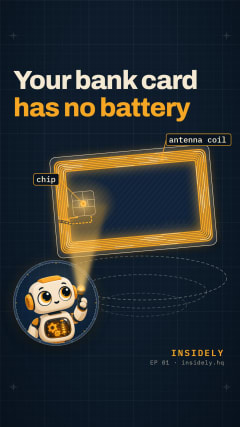
    The card has no battery: the reader's radio field powers the chip for a split second, and the chip creates a one-time code for that single payment, so a copied code is useless.

    In plain English

    Your bank card has no battery. So how does it pay in half a second? When you tap, the reader sends out an invisible magnetic field.

    That field powers a tiny chip and an antenna coil hidden inside your card. It creates a secret one-time code for that payment, and that code never works twice. Mastercard even requires the card to do its part in under a third of a second.

    And it all happens inside a card with no battery.

    Sources (7)

    1. No battery, powered by the reader's field (NFC, 13.56 MHz, ISO/IEC 14443): research paper arXiv 2302.08992, https://arxiv.org/abs/2302.08992
    2. A one-time code (cryptogram) for each payment that can't be reused: US Treasury Bureau of the Fiscal Service, EMV Merchant 101, https://fiscal.treasury.gov/files/cas/EMV_Merchant_101.pdf
    3. The same, in plain English: Spark glossary, EMV chip, https://www.spark.money/glossary/emv-chip
    4. Mastercard requires card processing under 300 ms for contactless products: Infineon press release, 16 Nov 2015, as published by the Secure Technology Alliance, https://www.securetechalliance.org/new-payment-platform-for-secured-and-ultra-fast-contactless-transactions
    5. Under half a second of interaction between card and reader: Visa patent US 7,798,394, https://patents.justia.com/patent/7798394 (also EP 2711889, https://data.epo.org/publication-server/rest/v1.2/publication-dates/20140326/patents/EP2711889NWA2/document.html)
    6. Antenna coil inside the card, outermost turn close to the card edge (full-size coils): NXP card coil design guide AN12342, https://www.nxp.com.cn/docs/en/application-note/AN12342.pdf
    7. Coil designs vary, and smaller antennas are used especially on embossed bank cards: research paper arXiv 1507.06427, https://arxiv.org/abs/1507.06427 (see also TU Graz, Optimizing Design of Smaller Antennas for Proximity Transponders, NFC 2010, https://www.computer.org/csdl/proceedings-article/nfc/2010/3998a077/12OmNylsZUz)

    Watch it

    Back to the top

Spotted a mistake in a source? Tell us on Instagram @insidely.hq and we'll put it right.

Tink's Pocket Guide from Insidely, insidelyhq.com/guide. Made with AI, checked by hand. Updated 18 October 2026.